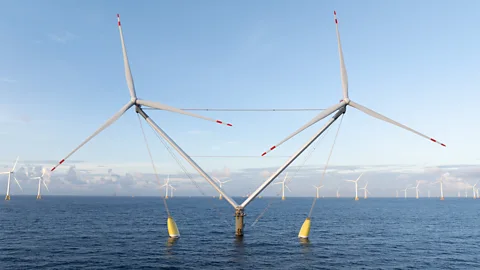
China is racing to develop a new generation of wind farms that can not only survive tropical cyclones, but also harness their power.
In southern China’s Guangdong province, a new skyline is taking shape away from its shores: hundreds of wind turbines have been installed in the South China Sea to generate renewable electricity for homes, offices and factories.
The enormous towers – some as tall as 30-storey buildings – are a symbol of China’s ambition for a greener future. Guangdong, one of the country’s offshore wind hubs, is already home to about 15% of all turbines installed in the ocean worldwide. Over the next five years, the local government plans to more than double that fleet.
These turbines are on the frontline of one of the most destructive weather phenomena on Earth, which hits China’s coast year after year: typhoons, tropical cyclones originating in the northwest Pacific.
These powerful storms bring winds at speeds of 119km/h (74mph) or higher. They terrorise East and Southeast Asian countries every May to November, and often leave a trail of death and destruction, including collapsed buildings and flooded streets. Typhoon Ragasa, which devastated southern China in September and was the world’s most powerful storm this year, reached speeds of 241km/h (150mph). Typhoons are the same phenomenon as hurricanes: they are both spinning storms fed by warm air, and just go by different names depending on where they occur. If they originate in the North Atlantic and northeast Pacific, they are called hurricanes; in the northwest Pacific, they are called typhoons.







Wow