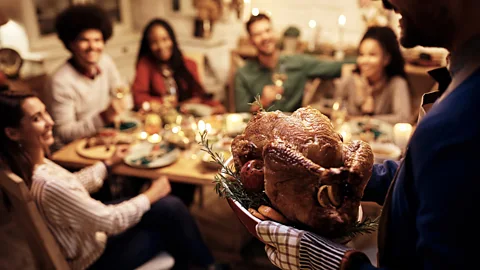
For thousands of years, humans have come together in small groups to feast on food. Why is it important – and why do we still continue the tradition?
It’s a peculiarly human universal: we like to sit down together for a good tuck-in. Meals out with friends, dinner parties, holiday get-togethers where we regularly overindulge – eating shared meals is so common that it’s rarely remarked upon, except when the idea that it’s not happening enough enjoys a societal vogue.
Panics about a decline in family dinners, for instance, regularly sweep through headlines. There is some evidence that such concerns are not a modern trend and may be at least a 100 years old. Eating together, all this suggests, is not only common, but somehow deeply powerful. But why?
Sharing food as a behaviour is likely to go back to before the origin of our species, as chimpanzees and bonobos, two of our closest primate relatives, also share food with their social groups, biologists have observed. But giving food to those closest to you is not the same as having a meal together, points out sociologist Nicklas Neuman of Uppsala University in Sweden. “You can distribute food as an object without sitting down and actually eating with others,” he says. Humans seem to have added a number of complex social layers to this act.
The first shared meal may have taken place around a campfire. No one is certain when humans or human ancestors first learned to cook – estimates vary wildly, with the oldest suggested date being 1.8 million years ago – but when someone has gone to the trouble of hunting or gathering food, putting together a fire, and then cooking over it, it implies that they may have a social group to help them with the many stages of this process.